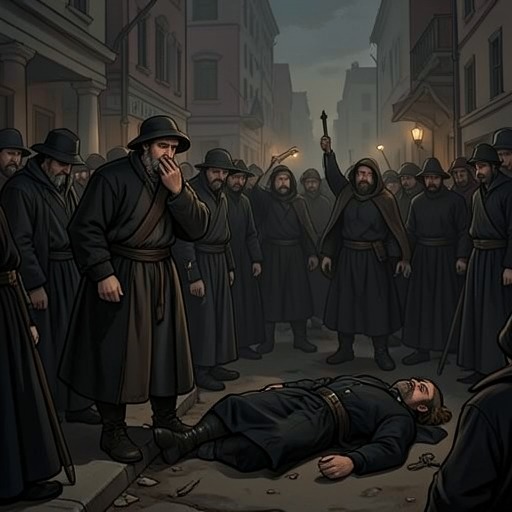
Silvio Luparello and Mrs. Luparello’s marriage
The Shape of WaterSilvio Luparello and Mrs. Luparello’s marriage is presented not as an intimate partnership but as a long-standing arrangement shaped by distance, discretion, and her clear-eyed knowledge of his private life. Her testimony complicates the respectable public image surrounding his death: she knows how he conducted his affairs, questions whether the circumstances fit his habits, and argues that the violence done to him was political rather than a straightforward act of murder.
Marriage and Distance
Mrs. Luparello describes the marriage as having changed decisively after the birth of their son. In her account, she and Silvio ceased to be a couple two years after the child was born. She says she did not reproach him for his affairs; instead, she watched him calmly for thirty years, believing that the absence of sexual jealousy allowed her to see him without the agitation of the senses. Her account makes the marriage’s distance more than a private detail: it is the condition that enabled her to observe the man behind his public standing.
She is careful about what she means by his affairs, explaining that the word does not specify the sex of the people involved. That distinction startles Inspector Montalbano, who has been considering the possibility that Silvio went to the Pasture with a woman. Mrs. Luparello’s knowledge does not establish the identity of the person with whom he died, but it makes the apparent explanation less convincing to her: she regards her husband as shrewd and ambitious, and doubts that he would risk recognition or blackmail in such a public, disreputable place after years of careful political manoeuvring.
Her account also distinguishes indulgence from self-destruction. Silvio, she says, gave in to his vices, but did not seek the kind of degradation that would expose him recklessly. He conducted his affairs discreetly at The Capo Massaria house, a small house he had built at Capo Massaria headland without putting it in his own name. Mrs. Luparello learned of the retreat through what she calls the customary compassionate friend. The concealed property and the discreet routine she describes sharpen the contrast between his private arrangements and the risky circumstances in which his body was found.
The Missing Keys and the Political Meaning of His Death
Mrs. Luparello’s account becomes practical as well as interpretive when she gives Inspector Montalbano a large yellow envelope and a ring holding two keys to the small house at Capo Massaria. She explains that Silvio was unusually particular about keys: he kept a duplicate set in a desk drawer and carried the other set on his person. The carried copy was never found. The missing keys turn a private habit into an investigative detail, linking the hidden retreat she has described to an unexplained absence in the evidence surrounding his death.
Her decision to approach Montalbano also reflects the guarded terms on which she acts. After learning where Silvio had been found, she telephoned the police commissioner to ask who was handling the investigation and whether there was one at all. The commissioner named Montalbano and described him as decent; still doubtful that such decency could be trusted, she had her son telephone the inspector. When they meet, she asks directly whether he is certain Silvio was not murdered. Her question is not simply a wife’s demand for reassurance: she is testing whether the official account can accommodate what she knows of her husband and the risks he took.
Mrs. Luparello draws a distinction between physical homicide and political violence. In her view, Silvio’s long preparation for public power makes the apparent circumstances of his death implausible: a man who had manoeuvred patiently into the open would hardly expose himself casually to recognition and blackmail. She therefore calls his death a political crime, an extreme act of violence that led to his death without necessarily constituting a conventional killing. Her formulation makes the marriage consequential to the investigation: years of separation had not made her indifferent, but had given her a vantage point from which to challenge both the respectable public legend and the simplest explanation of his last hours.
Public Reputation and Private Measure
Silvio’s public ascent gives the marriage’s private estrangement a political dimension. He inherited a family building business in Montelusa and, after graduating with highest honours from Milan Polytechnic, entered the Catholic political world, building alliances while remaining for years just behind its prominent figures. Eventually he gathered influence over party leaders and public contracts, then emerged as a standard-bearer for renewal and became provincial secretary only three days before his death. The newspapers’ portrait of generosity and self-effacing service sits uneasily beside Mrs. Luparello’s assessment of a shrewd, ambitious man who had spent years preparing to step into the open.
That contrast does not make her testimony a simple exposure of hypocrisy. She describes a marriage that had ceased to be a sexual partnership, yet her long observation of Silvio informs a precise judgment about the habits and risks he would—or would not—accept. Against the public commemoration of a newly elevated political leader, she insists that his death must be understood through the private life and calculated conduct she had watched at close range. Their separation, in her telling, left her outside his affairs but not ignorant of the man whose death suddenly made those affairs politically consequential.
Public Mourning and Private Candour
At a church gathering, Mrs. Luparello pretended to faint and had herself escorted out, not because she felt unwell but because she could not bear the hypocrisy around her. Her calculated exit offers a public counterpart to the private distance she describes in the marriage: she refuses to perform grief merely because the occasion demands it. When she later speaks with Montalbano, that candour shapes the encounter. Rather than preserve a comforting image of Silvio or accept the official account, she puts her doubts plainly before the inspector, making frankness—not conventional mourning—the form her response to his death takes.